IVF Over 50 years old | Here's why Mexico is THE option
 Edited by Michaël Veillette on January 28, 2026 at 2:30 PM
If you’re over 50 and were told “no” at home, you’re not alone
As an international coordinator, I speak every week with women in their early 50s. Sometimes mid-50s.
Almost all of them start the same way.
“My doctor said I’m too old.”
“We were told there’s nothing they can do.”
“They won’t even book a consult.”
If that sounds familiar, you’re not imagining things.
In the U.S. and Canada, many fertility clinics apply strict age cutoffs. Not because pregnancy suddenly becomes impossible at 50.
But because policies, insurance pressure, and liability concerns make it easier to say no than to have a real conversation.
That doesn’t mean you’re out of options.
It just means you need to look somewhere else.
What most clinics in the U.S. and Canada won’t say out loud
IVF over 50 is rarely about your ovaries. It’s about your overall health.
Most women pursuing IVF at this stage are considering donor eggs.
That shifts the question away from egg quality and toward medical readiness.
Blood pressure. Cardiac health. Metabolic screening.
Many clinics still rely on age as a filter.
It’s fast. It’s simple. And it avoids nuance.
But it also closes the door on patients who could absolutely move forward with the right medical supervision.
Why age cutoffs exist and why they’re not universal
Age limits are policies, not laws.
In North America, clinics often follow internal guidelines that cap treatment at 48 or 49.
Sometimes lower.
These limits vary widely from one clinic to another, but patients are rarely told that.
In Mexico, the approach is different.
There is no fixed age cutoff written in stone.
Treatment decisions are made case by case, based on medical evaluation, not a birthdate.
That difference alone is why so many American women over 50 start looking south.
And why they end up here.
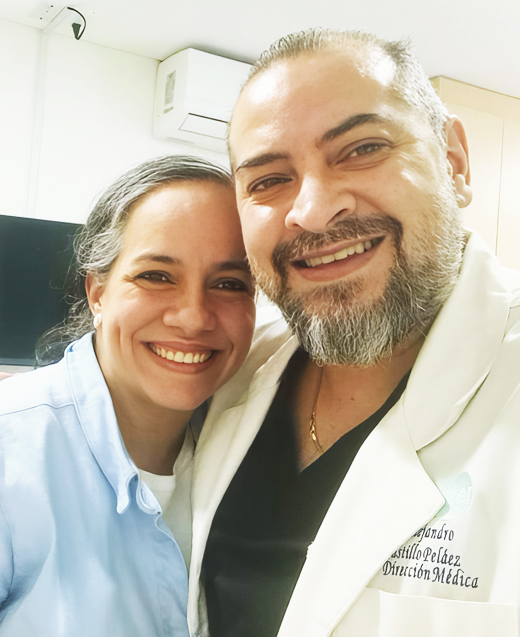
Dr. Castillo Peláez and IVF for women over 50
When it comes to IVF over 50, experience matters.
A lot.
Not just medical experience, but experience with patients who are coming from abroad, who’ve already been told no, and who need straight answers.
That’s why I work with Dr. Castillo Peláez in the first place.
Years of experience with American patients over 50
Dr. Castillo has worked with many women in their 50s coming from the United States.
These aren’t hypothetical cases or rare exceptions.
This is something his clinic sees regularly.
He understands the medical realities, but also the emotional side of it.
The frustration.
The urgency.
The need for clarity instead of vague promises.
Most of the patients I send his way are over 50 and using donor eggs.
He’s very direct about what’s possible, what’s not, and what needs to be evaluated before moving forward.
What makes his approach different
What I appreciate most is that he doesn’t start with a yes or a no.
He starts with a conversation.
You’re evaluated as a person, not a birth year.
Your health history.
Your test results.
Your expectations.
All of that matters.
And if something doesn’t make sense medically, he’ll tell you.
Clearly.
Early.
That saves people time, money, and false hope.
Case by case evaluation, not a blanket rule
There is no automatic approval.
And that’s a good thing.
Every patient over 50 is assessed individually.
Medical clearance is part of the process.
Safety comes first.
That’s exactly how it should be.
Clear expectations from the first consult
You won’t get vague answers or sales talk.
The first consultation is about understanding your situation and seeing if there’s a responsible path forward.
And yes, that consultation is free.
If you’re over 50 and considering IVF, the best next step is simply to talk to someone who does this every day.
Dr. Castillo is one of those people.
What IVF over 50 actually looks like, step by step
One of the biggest sources of stress I see is uncertainty.
Not knowing what the process really involves.
Not knowing how much time it takes.
Not knowing if you’ll be asked to move to Mexico for months.
So let me be very clear about how this usually works for women over 50.
Donor eggs are usually part of the plan
For most women over 50, IVF involves donor eggs.
That’s not a compromise.
That’s the medical reality that makes pregnancy possible at this stage.
Using donor eggs shifts the focus away from ovarian reserve and egg quality.
Instead, the priority becomes uterine health and overall medical readiness.
This is exactly why age alone doesn’t tell the full story.
I’ve seen women at 51 who were excellent candidates.
And others at 47 who were not.
Medical screening happens before anything else
Before treatment is approved, Dr. Castillo reviews your medical history in detail.
Blood work.
Cardiac evaluation if needed.
Clearance from your doctor back home.
This part isn’t rushed.
And it shouldn’t be.
IVF over 50 has to be approached responsibly.
The goal isn’t just pregnancy.
It’s a healthy pregnancy.
Time in Mexico is usually shorter than people expect
Another common fear is having to relocate for weeks or months.
That’s almost never the case.
Most patients spend about two to three weeks in Mexico, sometimes less.
A lot of the preparation happens remotely before you ever travel.
The clinic is used to working with international patients who can’t stay indefinitely.
Everything is organized around that reality.
Costs are often the deciding factor
I won’t pretend cost doesn’t matter.
For many patients, it’s the reason they start looking outside the U.S. in the first place.
IVF with donor eggs in Mexico is significantly more affordable than in the United States or Canada.
Even when you factor in travel and accommodations.
If you want a detailed breakdown, I strongly recommend reviewing our page on updated IVF cost in Mexico.
It lays everything out clearly, without surprises.
Who this path makes sense for and who it doesn’t
IVF over 50 isn’t for everyone.
And anyone who tells you otherwise isn’t being honest.
This path tends to make sense for women who are in good overall health, open to donor eggs, and comfortable traveling for care.
It’s usually not the right fit for someone looking for guarantees or shortcuts.
There are none.
What does exist is a realistic option.
One that many women never knew was still available to them.
And that’s why the conversation matters so much.
The next step is simple
If you’re over 50 and still asking yourself whether IVF is even possible, the best thing you can do is talk to someone who deals with these cases every day.
That’s exactly what the free consultation with Dr. Castillo is for.
No pressure.
No commitment.
Just clarity.
